Thursday, September 30, 2010

Samy to resign in January 2011.

KUALA LUMPUR: MIC’s longest serving president, Datuk Seri S. Samy Vellu, said he is stepping down in January to make way for his deputy Datuk G. Palanivel.
“Today, I’m officially announcing my decision to step down and pass the leadership to my deputy in January next year,” he told reporters after chairing the party’s Central Working Committee here.
He said that he had announced his decision to the CWC earlier.
Samy has held the presidency since 1979 for 11 consecutive terms.
He was the Works Minister of Malaysia and the longest serving minister in the Cabinet until he lost his parliamentary seat in the 2008 general elections.

tunku : THANK GOD. at last he's going away.we hope MIC will hold fresh election soon so that the movement will have strong leadership and make a strong comeback.the current leadership does not have strong supports from the grassroots.

Wednesday, September 29, 2010

Anwar Has Sinned Big By Tarnishing Malaysia's Image - Muhyiddin

KUALA LUMPUR, Sept 28 (Bernama) -- Tan Sri Muhyiddin Yassin regards PKR advisor Datuk Seri Anwar Ibrahim's action of tarnishing his own country's image in Indonesia as a big sin.
The deputy prime minister said Anwar was not a real leader as he was not responsible for what he said, in fact he was willing to say anything to destroy the country's image just to gain political mileage.
"It's all a big lie....'dosa kering' (wilful sinning).
"What Anwar has said is proof that he is prepared to lie and do anything to hurt the country to serve his own political interest and ambition," he said following Anwar's statement made in Indonesia in which he accused the Malaysian media of encouraging negative perception of Indonesia.
Muhyiddin was speaking to reporters after presenting a keynote address at the International Herald Tribune Forum, here Tuesday.
He said the people should also judge Anwar's actions of making baseless accusations and tarnishing Malaysia's image as irresponsible.
"I believe the media in Malaysia are responsible institutions and they have not exploited the (Malaysia-Indonesia) issues as what have been done by the Indonesian media."
Muhyiddin stressed that Malaysia and Indonesia had good relations at all levels and that the tension that occurred of late was caused by a small group of people in the republic.
On another matter, he believed Malaysia would fare better in attracting foreign investors if its image was not tainted by Anwar's infamous sodomy trial.
"Of course it's true that if there is no such case, Malaysia would be in a better position. But let's leave it to the court to decide, the sooner the case is disposed of, the better for us," he said.
He was asked to comment on Virgin Group founder Sir Richard Branson's remark on Monday that the ongoing trial was "a thorn" in Malaysia's otherwise good reputation.
On the remark, Muhyiddin said he would take it to mean that the British industrialist still saw Malaysia as a good destination for investment.
"I take his view as not interfering in Malaysia's internal affairs but in light of how to support Malaysia's initiatives to attract more investments," he added.

tunku :if anwar ever care about sin he would never involve in sodomizing activities.if he can sodomize, he can do anything.what is tarnishing country's image for him? he can even sell the country. after all indonesia is always close to anwar's heart because it is where sukma came from.

Tuesday, September 28, 2010

BUTT OUT RICHARD BRANSON.

Several issues are thorns in Malaysia’s side, says Branson

KUALA LUMPUR: Malaysia has a good reputation overseas but there are several issues which the country needs to tackle to attract investors, British tycoon and Virgin group founder Sir Richard Branson said.
He said although the current political climate would not affect Malaysia in a major way, the Government needed to take bold measures to address the issues.
“I do think that Malaysia has a good reputation overseas. Some of the issues like what’s happening to ex-deputy prime minister Anwar Ibrahim damages Malaysia a lot.
“I think that the more liberal Malaysia can be, the more people are going to want to invest here,” he said when responding to a question if Malaysia could achieve its aim of becoming a high-income nation at the “Dawn of the New Decade: Alternative Investment in Asia” conference here yesterday.

tunku : we don't need people like branson coming here to tell us about our law and moral.people like him can have sex with man but not us. in his country sodomy is legal but not here. we don't need sodomizer investors in our country. only a sodomizer investor will not invest in Malaysia in support of their sodomizer friend.so branson BUTT OUT and bring your butt friend with you.we hope next time the organizer won't call people with loose character to Malaysia for a talk.

Umno pays price for your words, Perkasa tells Nazri

KUALA LUMPUR, Sept 27 — Perkasa issued another warning to Datuk Seri Nazri Aziz today, saying that Umno would be the biggest losers if he continued attacking the Malay rights group.
Perkasa secretary-general Syed Hassan Syed Ali said today that the Umno man’s criticism would only serve to strengthen Perkasa’s influence.
He argued that Perkasa’s objective was to unite the Malays, and “rejecting” leaders who were splitting the race even if they were Malays themselves.
Syed Hassan dismissed Nazri’s remarks against the Malay-rights group, and likened those a child’s rants.
“I would advise Nazri to stop attacking Perkasa. Perkasa does not lose anything with Nazri’s attacks; in fact because of his attacks we are becoming stronger among the Malays.
“Perhaps Nazri too has nothing to lose. But the real loser is Umno if there are leaders within the party who are jealous of us and continue to belittle us like Nazri,” said the Perkasa secretary-general in a statement today.
Syed Hassan reiterated Perkasa chief Datuk Ibrahim Ali’s claims that although the Malay NGO was not a political party, it had enough clout to affect a politician’s standing with the Malay grassroots.
“Perkasa will not become a political party, that is for sure. But Perkasa can influence the position of a political leader. This is Perkasa’s warning. Nazri does not need to pressure Perkasa into becoming a political party. We know what we are doing. We want to unite the Malays,” said Syed Hassan.
Nazri yesterday challenged Ibrahim to reveal whatever secrets the Perkasa chief may have against him, in response to the latter’s warning to three Umno leaders to stop criticising Perkasa.

tunku : yesterday in the news, nazri was challenging perkasa to register as a political party and challenge bn in the coming election.nazri arrogantly told the reporters that the Malays will always vote for umno. this guy is mad.he is so arrogant that he became blind. he did not see the last election result.perkasa is a ngo.let it do what it is suppose to do. why nazri not hitting out at other ngo which is more racist than perkasa? is he "hired" by outsiders to destroy unity among umno members? there is hidden agenda here and najib should do something about it.it is time for umno members to kick this person out from umno.

Monday, September 27, 2010

AL FATIHAH- GALAS ASSEMBLYMAN DIES

KOTA BARU: Galas assemblyman Che Hashim Sulaiman died at 4.30pm Monday, at the Al-Islam Hospital in Kuala Lumpur, after a prolonged battle with colon cancer.
Che Hashim, 48, a PAS assemblyman, was diagnosed with colon cancer in 2009 and went to China last year to undergo chemotherapy treatment.
The one-term assemblyman was also involved in a road accident days after the last general election and was warded at the Raja Perempuan Zainab Hospital II here for cuts and bruises after his vehicle skidded into a ravine along the winding road in Gua Musang.

AL FATIHAH

Nik Aziz,The Not So Crazy For Power

I Not Crazy For Power, Says Nik Aziz

KOTA BAHARU, Sept 26 (Bernama) -- Kelantan Menteri Besar Datuk Nik Abdul Aziz Nik Mat said today that he was not crazy for power and was only continuing to lead the state at the behest of the leaders of PAS.
"Year after year, term after term, the party wanted me to continue as the MB of Kelantan," he told reporters at his office here Sunday.
The PAS spiritual leader said this in commenting on remarks made by former prime minister Tun Dr Mahathir Mohamad at a Perkasa gathering in Pasir Mas near here yesterday that Nik Aziz in wanting to continue to stay in power, was now compromising on Islamic principles by working together with political parties like the Chinese-dominant DAP.
Dr Mahathir had said that with the Malays disunited now and their allegiance equally spread out among Umno, PAS and Parti Keadilan Rakyat, it was not impossible that the Malays might become like their counterparts in Singapore where he said Malays and Muslims no longer had any power voice out their concerns.
Elaborating further, Nik Aziz said:"Among our former prime ministers, there have also been greedy ones. Could be he is also power crazy. Anyway, I thank him for the reminder."

tunku : before accusing others of power crazy, the senile old man should have a good look at himself first.all of our former prime ministers had resigned except for Tun Razak who died during his tenure as pm. nik aziz and other leaders in pakatan does not know the meaning of resign.it is not in their dictionary. they just want to stay in power till they die and they make sure that they do that no matter what it cause the people and the nation.

Sunday, September 26, 2010

Family dynasty in Pakatan Rakyat.

PKR's Accusation Of Dynasty, Cronyism In Umno Backfires - Shafie

SEMPORNA, Sept 25 (Bernama) -- The oft-repeated accusations by Parti Keadilan Rakyat (PKR) that Umno was building a dynasty and practised cronyism in its leadership has now backfired on PKR, said Umno vice-president Datuk Seri Mohd Shafie Apdal.
"They (PKR) can say Umno is a dynasty and has groups but they are even worse than what they accused us of," he told reporters at the Aidilfitri open house here.
He was commenting on the offer by Lembah Pantai MP Nurul Izzah, who is also PKR adviser Datuk Seri Anwar Ibrahim's daughter, to run for the vice-president's post in the party's forthcoming election.
Shafie said he did not rule out the possibility of money politics in the election process.
He said, all this while, PKR had accused Umno of having cronies but the latest development showed that PKR was the one which practised cronyism.
On the move by certain quarters to revive Usno, the United Sabah National Organisation, as its former leaders were sidelined by Umno, Shafie reminded them that Umno's entry to Sabah was to unite the bumiputera in the state.

tunku : if it is the pakatan's party then its ok, nothing is wrong,everything morally right but if it umno or bn component parties than they will bark day and night, shouting up and down of nepotism ,cronyism ,family dynasty etc. at least in umno, its members are brave enough to act against family dynasty but in pakatan it's members are cowards. dap is controlled by kit siang and karpal, meanwhile pkr by anwar.

Friday, September 24, 2010

Will pakatan stand up for the main suspects in Sosilawati murder case?

Sosilawati murder: Main suspect claims abuse by cops

KUALA LUMPUR: The main suspect in the murders of Datuk Sosilawati Lawiya and three others is claiming that he was punched, kicked and forced to sign documents against his will by the police.
Three lawyers representing the suspect and his brother, both lawyers, managed to meet their clients for the first time at the city police headquarters here Thursday.
They arrived at 3pm and were accompanied by the wives of the suspects who were also granted permission to meet their husbands.
Lawyer D.P. Vijandran and Ravi Nekoo, speaking to the press after the 30-minute meeting, said the 41-year-old suspect claimed he had been abused by the police.
"He claimed he was beaten with a hose, punched in the face and kicked, which aggravated an old spinal injury," Vijandran said, adding that his client has yet to receive medical treatment for his injuries.
The main suspect also claimed he was forced to sign documents against his will.
Vijandran said they would be lodging a police report on the alleged abuse Friday.
"My clients claim they have nothing to do with what (the murders) they are being investigated for and that they are innocent.
"Nonetheless, they are willing to give their full cooperation to the police but hope to be treated fairly at the same time," Vijandran said.
Meanwhile, the wives managed to meet their husbands for about 10 minutes, under the watchful eyes of the police.
"They were not allowed to get close to each other. The wives were very calm and dignified during the meeting," he added.
Sosilawati, 47, and three others — lawyer Ahmad Kamil Abdul Karim, 32, CIMB Bank officer Noorhisham Mohammad, 38, and driver Kamarudin Shansudin, 44, went missing on Aug 30. Their remains were later found in Ladang Gadong, near Banting.
Eight suspects have been detained, among them, the two lawyer brothers.

tunku : as expected these disgusting criminals will claim that they are innocents and been abused by the police. from what they have said regarding the abuse by the police force,i think it is still not enough.they deserve more than that. our police is too soft , they should be more aggressive against these crooks. i am wondering whether pakatan leaders will come to their defensive.will the bar council put big signboard in front of their office to support these crooks?after all they are from the same group.

Thursday, September 23, 2010

Arrest Warrant Will Be Issued If Shamsul Iskandar Won't Assist Investigations- CPO

SHAH ALAM, Sept 22 (Bernama) -- Police on Wednesday warned Parti Keadilan Rakyat (PKR) Youth chief Shamsul Iskandar Mohd Akin that a warrant of arrest will be issued against him if he continued to avoid assisting investigations into the murder of cosmetics millionaire Datuk Sosilawati Lawiya.
Selangor chief police officer (CPO) Datuk Khalid Abu Bakar said Shamsul Iskandar should come to the police if he really had evidence to support his allegations about the murder.
"However, till today he has not come forward and cannot be reached on his handphone. We are giving him ample opportunity to come an assist the police failing which we will invoke Section 111 of the Criminal Procedure Code for a warrant of arrest to be issued against him," he told reporters after receiving contributions of a mobile police station and three motorcycles from Sime Darby Property Bhd at the Selangor police headquarters here.
The vehicles worth RM617,250 were handed over by Sime Darby Property Bhd managing director, Tunku Datuk Putra Badlishah Tunku Annuar. Prior to this the media had reported that on Sept 13, Shamsul Iskandar, through the Selangor TV news portal, had alleged that police were involved in the murder of Sosilawati and three others.
Sosilawati, 47, her driver Kamaruddin Shamsudin, 44, lawyer Ahmad Kamil Abdul Karim, 32, and CIMB Bank officer Noorhisham Mohammad, 38, were killed, their bodies burnt and the ashes thrown into rivers in the vicinity of Ladang Gadong after they went missing on Aug 30 following a trip to Banting over a land deal.
Police have picked up eight suspects, among them two lawyers, in connection with the case.
Meanwhile, Khalid also issued a reminder to Kapar Member of Parliament S. Manikavasagam not to interfere in police work in the case.
"There is no need for politicians to try and become investigating officers. Stick to your job of serving the people and not do the work of the police," he said.
He was referring to Manikavasagam accompanying Indian national S. Usharani, to Ladang Gadong on Wednesday in connection with the disappearance of her husband Allal Kathan Muthuraja, 34, earlier this year.
The disappearance of Muthuraja has been linked to suspects in the murder of Sosilawati Lawiya and the three others.
Usharani, who had flown in from India, on Wednesday had also met the police in Banting over her husband's disappearance.

tunku : this cartoons think they are smart when they are only morons. they just want to be in the scene to be noticed by the public.we hope police will take action against them asap. shamsul should be brave enough to assist the police not chicken out when they call him.this is what happens when you talk craps all the time. as for manikavasagam...... go and join the police force if not stay far away from the scene. may be he had connections with the murder suspects....

Wednesday, September 22, 2010

Contractors Suffer From New Requirement Imposed By Selangor Government

PETALING JAYA, Sept 21 (Bernama) -- The Selangor MCA on Tuesday questioned the Selangor government's move requiring contractors and suppliers to register and get support from the State Economic Planning Unit (UPEN) in order to obtain projects.
State MCA Public Complaints Bureau deputy chairman Kelvin Chong Seng Foo said after the requirement was imposed, they received many complaints from contractors and suppliers on the difficulty of obtaining projects from the state government.
"It is not easy to get approval from UPEN. This will not only burden contractors and make it hard for Class F Bumiputera contractors to get projects, but also their non-Bumiputera counterparts," he said during a news conference at his office, here Tuesday.
He was commenting on a statement made by Kampung Tunku assemblyman, Lau Weng San, last week claiming that the state government ruled by the Parti Keadilan Rakyat-DAP and PAS coalition could not manage project approvals because contractor licences and projects were controlled by the central government.
Chong said the state government should clarify the need to register under UPEN, which he alleged was just to ensure contractors and suppliers supported the ruling party before being given a project.
At the same news conference, Selangor MCA Public Complaints Bureau chairman Datuk Theng Book said, until today, they received 71 complaints from the public about a company taking illegal cash deposits.
He said the company, which operated for the past three months, had caused the 71 victims to lose almost RM1.75 million.
Even worse, Book said the company could not be detected for action to be taken as they stopped operations after making enough profit.
"We will cooperate with the police and other parties to carry out a month-long campaign in October to create awareness among the public about illegal deposits," he added.

tunku : the move is to ensure that all the contracts are given to their cronies only.that's why they have to register with upen.not only register the applicants need supporting letters too. approval will be given only those who supports pakatan state government.this is what they call transparent.this is just the lower class, for class c,b and a they must give "donations" to the pakatan in order to get any job given by the state.even for private development on government's land, they need to give some kickbacks to them.transparent my foot.

Tuesday, September 21, 2010

Nazri Aziz a new hit for Pakatan Rakyat

Nazri maintains stand on putting nationality before race

PETALING JAYA: Minister in the Prime Minister’s Department Datuk Seri Nazri Abdul Aziz has maintained that he is a Malaysian first and a Malay next.
“Does any bigot have a problem with that?” he said in an open letter to an online news portal to refute a Mingguan Malaysia column written by Awang Selamat titled “Alahai Nazri” on Sunday.
Awang had questioned Nazri’s criticism of Datuk Ibrahim Ali, saying the minister had treated the Perkasa president as though he was an enemy of Umno.
The columnist also accused Nazri of being anti-Tun Dr Mahathir Mohamad.
DAP adviser Lim Kit Siang, in his blog, congratulated Nazri for being the first in the Cabinet to declare he was Malaysian first and put race second.

tunku: we challenge nazri to contest in non Malay majority constituency in the next election if he has the guts.let us see whether the voters there think of him as a Malaysian first and Malay later.he can try at Ipoh or Batu Gajah, that too if he is man enough to take the challenge.he is becoming a hit for pakatan.we suggest he contest under pakatan for the next election.

TI Malaysia Calls PKR For A Clean Election


KUALA LUMPUR, Sept 20 (Bernama) -- Transparency International - Malaysia (TI Malaysia) hopes the Parti Keadilan Rakyat (PKR) election will be conducted fairly, responsibly and free of money politics.
Its president, Datuk Paul Low Seng Kuan said the calls made by TI Malaysia was to ensure that candidates would be elected based on their integrity, competency, and commitment to serve the people without the influence of money.
"The people are watching closely, therefore, if PKR stands for a clean, accountable and transparent governance, then all its candidates must walk the talk (must be consistent with their promises, words and actions) and refrain from money politicking," he said in a statement here on Monday.
TI Malaysia is a non-governmental organisation to counter corruption on a national and international level.
Low said the coming PKR party election that is scheduled in November would be closely watched by people who had an interest in the outcomes or the process as an indication as to whether PKR could be trusted to form a credible government.
The interest was not only on who was standing for what position but also on how the whole election process was being conducted, unfortunately, too many internal political party elections had been tainted by money politics, he said.
"Money politics is political corruption and it is the source of all corruption as it will not only undermine the democratic process of election but makes the candidates to be beholden to their funders and detrimental to the people," he said.
In a news report on a local daily, Sinar Harian on Monday, PKR vice-president Azmin Ali said that the direct involvement of thousands of members in choosing a candidate at the PKR election would not create any bribery or money politics.
According to Sinar Harian, Azmin is still leading the race compared to other PKR candidates in obtaining (35) nomination, followed by Central Leadership Council Member Datuk Zaid Ibrahim (19), Vice-President Mustaffa Kamil (10) while the party Strategy Director Tian Chua receives two nomination.

tunku : pkr party election will never be clean as it has anwar and his "buddies" as their leaders. don't forget it was anwar who introduce money politics in umno.he used money politics to be the deputy president of umno and now they will use it again to make sure azmin and several others wins.those who sees pkr stands for a clean, accountable and transparent governance are actually truly blind people.pkr is the mother of all corruptions.

Monday, September 20, 2010

Umno And Perkasa Champion Malay Rights On Different Platforms

KUALA LUMPUR, Sept 19 (Bernama) -- Although Umno and Perkasa champion Malay rights, they are on different platforms where Umno does it as a political party while Perkasa is a non-governmental organisation, says Umno deputy permanent chairman Datuk Mohamed Aziz.
However, he said, Umno's struggle was wider as it not only concerned the Malays but also the other races in the country.
"There is actually no conflict in objectives. Perkasa has its own struggle while Umno's is clear that it does not sideline the interests of the other races.
"This is the unique thing about Umno. And this is what makes Malaysian society a plural but united society," said Mohamed, who is also Sri Gading member of parliament, at the constituency's Aidilfitri function, here, Sunday.
"It's just like the other non Malay-based organisations which fight for their respective community's rights. We didn't comment on it. It's their right.
"Likewise, the MCA, MIC, Gerakan, PPP and other Barisan Nasional component parties look after the racial communities they represent, but they also realise that the interests of the other races also need (the government's) attention."
Mohamed said Perkasa would be treated the same as other NGOs, and there was no need for Umno to distance itself from Perkasa.
"It should be like Umno's relations with the Girl Guide movement, Scout movement, St John's Ambulance and Malaysian Red Crescent Society. Each has its own responsibilities and goals, and looks for what is good for society."
Mohamed said if there were Umno leaders who felt that the party should distance itself from Perkasa, it was their personal views and did not reflect the party's stand.

tunku : although they are on different platforms they do not need to be enemies.instead they should work together where concerns.umno should not have allowed kj and nazri aziz to slam whoever supports perkasa. perkasa has hundred thousands of voters.do not forget that and some of them are even umno members. nazri aziz as usual talks big and Najib is not doing anything about it. act before its too late. let nazri join the opposition as he's been talking with their voice lately.let him join zaid ibrahim.umno does not need leaders like him. now he has even made awang selamat as his enemy, is this good for Umno?

Wednesday, September 15, 2010

Khairy slams Utusan's support of Perkasa

Even as Umno and BN leaders distance themselves from Malay rights pressure group Perkasa, Malay-language daily Utusan Malaysia continues to support the group.
In today's edition, the Umno-owned broadsheet devoted an entire page to an assortment of stories defending the NGO, including a poll headlined 'Majority of Malays support Perkasa'.

In response, Umno Youth chief Khairy Jamaluddin Abu Bakar - one of the most vocal critics of Perkasa - launched a thinly-veiled attack on the daily on his Twitter account.
He tweeted that he “thinks a particular newspaper needs to be reminded who its owners are”.
“I'm advocate for reforms towards a free and responsible press but while in present paradigm, I can't accept editorial line of particular daily,” he said next.
Although Khairy did not name names, the statement was clearly aimed at Utusan.
He has repeatedly claimed that Umno is not in cahoots with Perkasa in any way.
Over the past week, Umno bigwigs including secretary-general Tengku Adnan Tengku Mansor, vice-president Ahmad Zahid Hamidi and supreme council member Mohamed Nazri Abdul Aziz have begun voicing criticism of Perkasa.
They claimed that its hardline views on Malay rights could alienate non-Malay voters in the next general election.
Utusan has backed Perkasa with several stories and its Sunday opinion columns have urged Umno to rethink its stand in rejecting Perkasa.
Among the most recent stories was one quoting the Perak government's information chief Hamdi Abu Bakar, who reportedly said that the Umno leaders' move to distance themselves from Perkasa is syok sendiri (self-serving).
Umno's stance has not deterred Perkasa president Ibrahim Ali and the 50,000 members that he claims to lead.
He has gone so far as to warn Umno, a party of 3.4 million members, that he can give “guidance” to Perkasa members on how to vote in the general election.

tunku : what's wrong with utusan supporting perkasa? if chinese and indians can have their ngo's why can't the malays? other races can have everything but not the malays.if the malays do someting than its racist but not others. where's the logic here? kj,nazri aziz and ku nan must be smart enough to differentiate between a political party and a ngo.perkasa is not a political party,it is only a ngo that uphold the malays right.kj the namewee production actor knows the fact that his days are numbered in umno.he's preparing to jump ship.that is why he's making stupid remarks all the time.this is from his tweeter "Khairykj Setuju dgn Nazri Aziz. Kalau anak jantan, IbAli patut daftar Perkasam sbg parti poltik, masuk gelanggang & lawan." this is not the level of a ketua pemuda.

Thursday, September 9, 2010

EID MUBARAK 2010 / 1431


EID MUBARAK / SELAMAT HARI RAYA AIDIL FITRI TO ALL .
MINAL AIDIN WAL FAIDZIN
Wish you all a happy and peaceful Eid-Ul-Fitr and may ALLAH bless and reward all of you with the blessings of Heaven.
from home to home, and heart to heart,
from one place to another
the warmth and joy of EID,
brings us closer to each other.

Please keep up all the good deeds which you have done during Ramadhan.

MAAF ZAHIR BATIN KEPADA SEMUA UMAT ISLAM.

Tuesday, September 7, 2010

The Meaning of Eid

Eid means recurring happiness or festivity. There are two such Eid in Islam. The first is called Eid al-Fitr (the Festival of Fast Breaking).
It falls on the first day of Shawwaal, the tenth month of the Muslim year, following the month of Ramadhaan in which the Holy Qur’an was revealed and which is the month of fasting.
The second is called Eid al-Adhaa (the Festival of sacrifice). It falls on the tenth day of Zulhijjah, the final month of the Muslim year. The Islamic Eid are unique in every way. To them there can be nothing similar in any other religion or any other sociopolitical system. Besides their highly spiritual and moral characteristics, they have matchless qualities.
Each Eid is a wholesome celebration of a remarkable achievement of the individual Muslim in the service of Allah SWT. The first Eid comes after an entire month of 'absolute' fasting during the days of the month. The second Eid marks the completion of Hajj to Mecca, a course in which the Muslim handsomely demonstrates his renouncement of the mundane concerns and hearkens only to the eternal voice of Allah SWT.
Each Eid is a thanksgiving day where Muslims assemble in a brotherly and joyful atmosphere to offer their gratitude to Allah SWT for helping them to fulfill their spiritual obligations prior to the Eid. This form of thanksgiving is not confined to spiritual devotion and verbal expressions. It goes far beyond that to manifest itself in a handsome shape of social and humanitarian spirit. The Muslims who have completed the fasting of Ramadhaan express their thanks to Allah SWT by means of distributing alms among the poor and needy on the first Eid before the prayer.
Eid also is a day of remembrance. Even in their most joyful times the Muslims make a flesh stall of the day by a plural session of worship to Allah SWT. They pray to Him and glorify His name to demonstrate their remembrance of His favors. Along with that course, they remember the deceased by praying for their souls, the needy by extending a hand of help, the grieved by showing them sympathy and consolation, the sick by cheerful visits and utterances of good wishes, the absentees by cordial greetings and sincere considerateness. Thus, the meaning of remembrance on the day transcends all limits and expands over far-reaching dimensions of human life.
Most of the imaam when delivering the Eid khutbah will mention that Eid is a day of victory. The individual who succeeds in securing his spiritual rights and growth receives the Eid with a victorious spirit. The individual who faithfully observes the duties, which are associated with the Eid, is a triumphant one. He proves that he holds a strong command over his desires, exercises a sound self-control and enjoys the taste of disciplinary life.
Once a person acquires these qualities, he has achieved his greatest victory because the person who knows how to control himself and discipline his desires is free from sin and wrong, from fear and cowardice, from vice and indecency, from jealousy and greed, from humiliation and all other causes of enslavement. Therefore, when he receives the Eid, which marks the achievement of this freedom, he is in fact celebrating his victory, and the Eid thus becomes a day of victory.
This is the proper meaning of an Islamic Eid. It is a day of thanksgiving, a day of festive remembrance and a day of moral victory. An Islamic Eid is all this and is much more because it is a day of Islam, a day of Allah SWT. Celebrate this coming Eid with the true imaan and taqwa. InshaaAllah, besides having enjoyment, we will be blessed by Allah SWT.

Sunday, September 5, 2010

I'TIKAF

1. I'TIKAF in the first ten and in the mid ten days of Ramadan:

Abu Sai'id Al-Khudri Radiyallahu Anh narrated that the Messenger of Allah (PBUH) observed I'tikaf in the first ten days of Ramadan; he then observed I'tikaf in the middle ten days in a Turkish tent with a mat hanging at its door. The Prophet (PBUH) took hold of that mat and place it in the nook of the tent. He then put his head out, and talked with people who came nera him, and he said: I observed I'tikaf in the first ten nights and days in order to seek that night (Night of Decree). I then observed I'tikaf in the middle ten days. Then an angel was sent to me, and I was told that this night is among the last ten nights. He who among you like to observe I'tikaf may do so," and people observed it along with him, and he again said: "That Night of Decree was shown to me in an odd night and I saw in the dream that I was prostrating in the morning in mud and water." So in the morning of the twenty-first night when the Prophet (PBUH) got up for dawn prayer, there was rainfall and the mosque dripped, and I saw mud and water. When he came out after he finished the morning prayer, he saw that his forehead and the tip of his nose had traces of mud and water, and that was the twenty-first night of the last ten nights of Ramadan. (Bukhari 2018). (Source: Summarized Sahih Muslim, Volume 1, Hadith 632)

2. I'tikaf in the last ten days of Ramadan
'Aishah Radiyallahu Anha narrated that the Prophet (PBUH) was regular in observing I'tikaf in the last ten (days) of Ramadan until Allah, the Exalted and Glorious, collected him. His wives also used to observe I'tikaf with him. (Bukhari 2026). (Source: Summarized Sahih Muslim, Volume 1, Hadith 633)

2.1. Striving hard in the last ten (of Ramadan)
'Aishah Radiyallahu Anha narrated that when the last ten nights of Ramadan began the Messenger of Allah (PBUH) kept awake at nights (for prayer and worship), awoke his family, strove hard and fastened his lower garment. (Bukhari 2024) (Source: Summarized Sahih Muslim, Volume 1, Hadith 634)

3. Lailat-ul-Qadr (Night of Decree) and seeking it in the last ten (nights) of Ramadan
Ibn 'Umar Radiyallahu Anhuma narrated that the Messenger of Allah (PBUH) said: "Seek it (Lailat-ul-Qadr) in the last ten (nights). If one of you shows slackness in the earlier part of Ramadan, let it not be weak to observe the last seven." (Bukhari 2015) (Source: Summarized Sahih Muslim, Volume 1, Hadith 635)

4. Lailat-ul-Qadr was the twenty-third night of Ramadan
'Abdullah bin Unais Radiyallahu Anh narrated that the Messenger of Allah (PBUH) said: "I was shown Lailat-ul-Qadr; then I was made to forget it. I saw that I was prostrating in water and mud in the morning of that night." The narrator said: There was a downpour on the twenty-third night and the Messenger of Allah (PBUH) led us in prayer, and as he went back, there was a trace of water and mud on his forehead and on his nose. The narrator added: "Abdullah bin Unais used to say that it was the twenty-third night. (Source: Summarized Sahih Muslim, Volume 1, Hadith 636)

5. Seek it (Lailat-ul-Qadr) in the ninth and seventh and the fifth (in the last ten nights of Ramadan):
Abu Sa'id Al-Khudri Radiyallahu Anh narrated: The Messenger of Allah (PBUH) observed I'tikaf in the middle ten days of Ramadan to seek Lailat-ul-Qadr, before it was shown to him. When these nights were over, he ordered a tent to be pitched. Then it was shown to him that (Lailat-ul-Qadr) was in the last ten nights of Ramadan. Then he ordered to pitch the tent again. He then came to people and said: "O people, Lailat-ul-Qadr was shown to me and I came out to tell you about it, but two man were quarrelling with each other, and there was a devil along with them, and I forgot it. So seek it in the last ten nights of Ramadan. Seek it on the ninth, on the seventh and on the fifth." One of the narrators said: "Abu Sa'id, you know more than about numbers." He said: "Yes, indeed we know better than you." I said: "What is this ninth, seventh, and fifth?" He said: "When twenty-one nights are over and the twenty-second begins, it is the ninth; and when twenty-three nights are over, that which follows is the seventh; and when twenty-five nights are over, what follows is the fifth." (Bukhari2016) (Source: Summarized Sahih Muslim, Volume 1, Hadith 637)

Saturday, September 4, 2010

Zakaah al-Fitr

1. MEANING

Zakaah al-Fitr is often referred to as Sadaqah al-Fitr. The word Fitr means the same as Iftaar, breaking a fast and it comes from the same root word as Futoor which means breakfast. Thus, Islamically, Zakaah al-Fitr is the name given to charity which is distributed at the end of the fast of Ramadaan.

2. CLASSIFICATION

Sadaqah al-Fitr is a duty which is Waajib on every Muslim, whether male or female, minor or adult as long as he/she has the means to do so.
The proof that this form of charity is compulsory can be found in the Sunnah whereby Ibn `Umar reported that the Prophet (sallallaahu `alaihi wa sallam) made Zakaah al-Fitr compulsory on every slave, freeman, male, female, young and old among the Muslims; one Saa` of dried dates or one Saa` of barely. [collected by Bukhaaree - Arabic/English, vol. 2, p. 339, no. 579]
The head of the household may pay the required amount for the other members. Abu Sa'eed al-Khudree said, "On behalf of our young and old, free men and slaves, we used to take out during Allaah's Messenger's (sallallaahu 'alaihi wa sallam) lifetime one Saa` of grain, cheese or raisins". [collected by Muslim - English transl. vol. 2, p. 469, no. 2155]

3. SIGNIFICANCE

The significant role played by Zakaah in the circulation of wealth within the Islamic society is also played by the Sadaqah al-Fitr. However, in the case of Sadaqah al-Fitr, each individual is required to calculate how much charity is due from himself and his dependents and go into the community in order to find those who deserve such charity. Thus, Sadaqah al-Fitr plays a very important role in the development of the bonds of community. The rich are obliged to come in direct contact with the poor, and the poor are put in contact with the extremely poor. This contact between the various levels of society helps to build real bonds of brotherhood and love within the Islamic community and trains those who have, to be generous to those who do not have.
4. PURPOSE

The main purpose of Zakaah al-Fitr is to provide those who fasted with the means of making up for their errors during the month of fasting. Zakaah al-Fitr also provides the poor with a means with which they can celebrate the festival of breaking the fast (`Eed al-Fitr) along with the rest of the Muslims.
Ibn Abbaas reported, "The Prophet (sallallaahu 'alaihi wa sallam) made Zakaah al-Fitr compulsory so that those who fasted may be purified of their idle deeds and shameful talk (committed during Ramadaan) and so that the poor may be fed. Whoever gives it before Salaah will have it accepted as Zakaah, while he who gives it after the Salaah has given Sadaqah." [collected by Abu Dawood - Eng. transl. vol. 2, p. 421, no. 1605 - rated Saheeh by Shaikh Naser Al-Albanee]
Hence, the goal of Sadaqah al-Fitr is the spiritual development of the Believers. By making them give up some of their wealth, the believers are taught the higher moral characteristics of generosity, compassion (sympathy for the unfortunate), gratitude to God and the righteousness. But, since Islaam does not neglect man's material need, part of the goal of Zakaah al-Fitr is the economic well-being of the poorer members of society.

5. CONDITIONS

Zakaah al-Fitr is only Waajib for a particular period of time. If one misses the time period without a good reason, he has sinned and can not make it up. This form of charity becomes obligatory from sunset on the last day of fasting and remains obligatory until the beginning of Salaah al-'Eed' (i.e. shortly after sunrise on the following day). However, it can be paid prior to the above mentioned period, as many of the Sahaabah (companions of the Prophet(sallallaahu 'alaihi wa sallam) ) used to pay Sadaqah al-Fitr a couple days before the `Eed.
Naafi reported that the Prophet's companion Ibn `Umar used to give it to those who would accept it and the people used to give it a day or two before the `Eed. [collected by al-Bukhaaree - Arabic/English, Vol. 2, p.339, no. 579]
Ibn `Umar reported that the Prophet (sallallaahu 'alaihi wa sallam) order that it (Zakaah al-Fitr) be given before people go to make the Salaah (al-'Eed).
And Ibn `Abbaas reported that the Prophet (sallallaahu 'alaihi wa sallam) said, "Whoever gives it before the Salaah will have it accepted as Zakaah, while he who gives it after the Salaah (will not, for it will only be considered as) ordinary charity." Therefore, one who forgets to pay this Zakaah al-Fitr on time should do so as soon as possible even though it will not be counted as Zakaah al-Fitr.
6. RATE

The amount of Zakaah is the same for everyone regardless of their different income brackets. The minimum amount is one Saa` (two handfuls ) of food, grain or dried fruit for each member of the family. This calculation is based on Ibn `Umar's report that the Prophet(sallallaahu 'alaihi wa sallam) made Zakaah al-Fitr compulsory and payable by a Saa` of dried dates or a Saa` of barley.
The Sahaabee, Abu Sa`eed al-Khudree said, "In the Prophet's time, we used to give it (Zakaah al-Fitr) as a Saa` of food, dried dates, barley, raisins or dried cheese". [collected by al-Bukhaaree - Arabic/English vol. 2, p. 340, no. 582]
MALAYSIA ZAKAAH PAYMENT

Negeri

Kadar Zakat Fitrah 2010 (RM)

Perlis

6.00

Kedah

7.00

Pulau Pinang

7.00

Perak

7.00

Selangor

7.00

Negeri Sembilan

6.50

Melaka

6.50

Johor

5.00 / 7.50 *

Pahang

7.00

Terengganu

5.00 / 7.00 / 8.00*

Kelantan

7.00

Sarawak

5.20

Sabah

6.80

Wilayah Persekutuan

7.00

Friday, September 3, 2010

Maximize the last 10 days of Ramadan

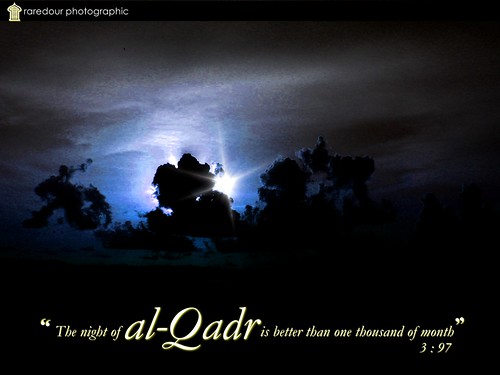
Laylatul Qadr (the Night of Power) is described in the Quran as, "better than a thousand months" (97:3). Any action done on this night such as reciting the Quran, remembering Allah, etc. is better than acting for one thousand months which do not contain the night of Qadr.
Allah's Messenger used to exert himself in devotion during the last ten nights to a greater extent than at any other time." (Muslim). Allah's peace and blessings be upon our beloved Prophet.
Aisha, may Allah be pleased with her, related that the Prophet said: Look for Laylatul Qadr on an odd-numbered night during the last ten nights of Ramadan (Bukhari).
The Prophet said: "Whoever prays during the night of Qadr with faith and hoping for its reward will have all of his previous sins forgiven." (Bukhari and Muslim recorded from Abu Huraira).
Here are some tips of things we can do on the Night of Power and the time before and after it.

1. Take a vacation for Allah.

We take a break from our jobs for almost everything in life. Why not this time to focus on worshiping and thanking our Creator.
If this is not possible at least take a few days off if you can. This can make it easier to stay awake at night to do extra Ibadah, not having to worry about getting to work the next day. It will also facilitate doing Itikaf.

2. Do I'tikaf.

It was a practice of the Prophet to spend the last ten days and nights of Ramadan in the masjid for I'tikaf.
Those in I'tikaf stay in the masjid all this time, performing various forms of zikr (the remembrance of Allah), like doing extra Salat, recitation and study of the Quran. They do not go outside the masjid except in case of emergencies, therefore, they sleep in the masjid. Their families or the masjid administration takes care of their food needs. I'tikaf of a shorter period of time, like one night, a day or a couple of days is encouraged as well.

3. Make this special Dua.

Aisha, may Allah be pleased with her, said: I asked the Messenger of Allah: 'O Messenger of Allah, if I know what night is the night of Qadr, what should I say during it?' He said: 'Say: O Allah, You are pardoning and You love to pardon, so pardon me.' "(Ahmad, Ibn Majah, and Tirmidhi).
The transliteration of this Dua is "Allahumma innaka 'afuwwun tuhibbul 'afwa fa'fu 'annee"

4. Recite the Quran.

Perhaps you can choose Surahs or passages from the Quran, which you have heard in Tarawih this past Ramadan to recite.
If you attend a class where the recitation of the Quran is taught, this is a great time to put your knowledge into practice.

5. Reflect on the meaning of the Quran.

Choose the latest Surah or Surahs you've heard in Tarawih and read their translation and Tafseer. Then think deeply about their meaning and how it affects you on a personal level.

6. Get your sins wiped out.

Abu Huraira narrated that the Messenger said: Whoever stands (in prayer) in Laylatul Qadr while nourishing his faith with self-evaluation, expecting reward from Allah, will have all of his previous sins forgiven. [Bukhari and Muslim).
Don't just pray using the shorter Surahs that you know. Try to make your prayers longer, deeper and meaningful. If you are familiar with longer Surahs, read the translation and explanation and then pray reciting these Surahs, carefully reflecting on the meaning while you pray.
Even if you are only familiar with the shorter Surahs, read the translation and explanation beforehand, and then pray reflecting on the message of the Surahs.
This is a good way to develop the habit of concentration, even in regular prayers, where many of us tend to be fidgety and/or easily distracted.

7. Make a personal Dua list.

Ask yourself what you really want from Allah. Make a list of each and everything, no matter how small or how big it is, whether it deals with this world or not. Allah loves to hear from us. Once this list is ready, you can do three things:
* Ask Allah to give you those things
* Think about what actions you have taken to get those things
* Develop a work plan to get those things in future.

8. Evaluate yourself.

Ask yourself those questions that need to be asked. Do an evaluation of where you are and where you are going. Let this evaluation lead you to feel happiness for the good you have done and remorse for the bad you have done. This latter feeling should make it easier to seek Allah's sincere forgiveness when making the Dua mentioned in tip number one above.

9. Make long, sincere and deep Duas

One of the best times to do this is during the last part of the night.
Abu Huraira, may Allah be pleased with him, related that the Prophet said: When the last one-third of the night remains, our Lord, the Glorious One descends towards the heaven of the earth and proclaims: Who is that who supplicates for Me, and I grant his supplication? Who is that who begs Me for anything and I grant it to him? And who is that who seeks My forgiveness, and I forgive him? (Bukhari, Muslim).
That means for instance, waking up one hour before Suhoor time to ask Allah for anything and everything you want that is Halal. This can be done using the Duas of the Sunnah, but also Dua in your own language, with sincerity and conviction.

10. Memorize a different Dua every night

They don't have to be long. They can be just one line. And be sure to know what they mean generally at least, even if you don't know the exact translation in English.
You can put them on index cards (or and keep them with you during the day, glancing at them during work, while driving, waiting in line, etc.) Then practice them at night in prayer.

11. Have Iftar with the family

If you've spent Iftar time on weekdays in your cubicle at work alone with a couple of dates, now is the last few days you'll have this Ramadan to spend with your family. Use it wisely.

12. Take the family to Tarawih

Have your spouse and kids missed Tarawih most of Ramadan because you weren't there to drive them to the Masjid, which is too far away to walk to? If so, do all of yourselves a favour and bring everyone for Tarawih in these last ten nights.

13. Attend the Dua after the completion of Quran recitation

Almost all Masjids where the Imam aims to finish an entire reading of the Quran in Tarawih prayers in Ramadan will be completing their recitation in these last ten nights. They may try to end on one of the odd nights and read the Dua at the end of a reading of the Quran. Attend this particular night's Tarawih prayer with your family. See if you can attend different Masjids' Tarawih prayers the night they finish reading the Quran.

14. Finish reading a book on the Prophet

Read about the Prophet's life, which can increase your love for him and Islam by seeing how much he struggled for Allah's sake. It may inspire you to push yourself even harder during these last ten nights. This community is built on sacrifice.

15. Plan for the next year

Once you've done a self-evaluation, you can plan on where you want to go, at least in the next 12 months. Laylatul Qadr is a great night to be thinking about this (without taking away from your worship), since you'll Insha Allah, be in a more contemplative state. You may choose to dedicate one night of power for evaluation and one night for planning for the next year.

16. To do list for the Night of Power

Make a to do checklist for each Night of Power. This should define how you would like your night, the one better than a thousand months, to be used. Pick things from this list and define the sequence you would like to do things in. This will help you avoid wasting your time in unproductive chats which common in the festive atmosphere of Masjids at the Night of Power.

Thursday, September 2, 2010

Indonesian maid stomps infant to death

SERDANG: An Indonesian maid allegedly stomped a 15 month-old-infant to death in Puchong and then disappeared.
It is learnt the incident occurred at 4pm last Friday when the only child was found unconscious at his home by a relative.
It is learnt the 25-year-old Indonesian maid from Majalingka, West Jawa had called the victim’s father to inform his son had fallen ill and was unconscious.
The victim’s father, Tang Meng Kiang, 40, a businessman asked his relative who lived nearby to rush his son to a nearby private hospital.
However, the infant, Tan Jin Yang was pronounced dead on arrival.
Serdang OCPD Supt Abdul Razak Elias said that, initially, the case was classified as sudden death.
However, the post mortem from the Serdang Hospital revealed numerous elements of fould.
It is learnt the child had strangulation marks on his neck, internal brain haemorrhage, bruises believed to be from being stepped on and lung infection.
“In light of the post mortem results, we re-classified the case as murder and have been on the lookout for who could help shed light on the child’s death,” he said.
Further investigations revealed that the maid had been working with the businessman’s family for nearly two years.
“At one point, the parents suspected their son was abused when one of his legs was fractured, but they did not follow through their suspicions”, he said.

tunku : we are the one that should protest for the bad behaviors of the indonesians but instead things are going the other way round.here is the example how bad and dirty are their people in Malaysia.hope police will haunt the maid and punish her to the maximum. that is why there's always natural disaster in indon.ganyang indon.

Thank You Tan Sri Musa Hassan

Ismail Omar Is New IGP, Hussin Ismail As Deputy

PUTRAJAYA, Sept 1 (Bernama) -- Deputy Inspector-General of Police Tan Sri Ismail Omar has been recommended to take over the post of Inspector-General of Police (IGP) from Tan Sri Musa Hassan whose contract ends on Sept 12, Home Minister Datuk Seri Hishammuddin Tun Hussein said.
He said Internal Security and Public Order Director Datuk Hussin Ismail had been recommended for the post of Deputy IGP.
"The posts of IGP and Deputy IGP are special posts under Article 140 of the Federal Constitution and appointments to the post must be consented to by the Yang di-Pertuan Agong," he told a news conference.
Asked when the matter would be brought before the Yang di-Pertuan Agong, Hishammuddin said it would depend on Prime Minister Datuk Seri Najib Tun Razak.
To a question, he said the decision not to renew Musa's contract was not due to pressure from any group.
"It just happens that the IGP's tenure expires on Sept 12. It's time for a successor to come and fill in the position.
"That process will carry on and our struggle to ensure a better police force and to ensure the country is safe will continue," he said.
Hishammuddin also said that the government was looking into how Musa could continue to contribute his expertise, saying he would be the best candidate to lead the proposed training academy to tackle trans-border crime such as cyber crime, human trafficking, drug smuggling, money laundering and terrorism, based in Langkawi.
"On behalf of the government I would like to record our highest appreciation to Tan Sri Musa for his service in the police, spanning over a period of 41 years.
"I would be very glad if he could lead the proposed academy and I believe he has the capability to make it a renowned police training academy in the world," he said.
Musa said the time had come for him to retire from the police force after four decades of service.
Speaking to reporters after the announcement by Hishammuddin, Musa said he had given his best to the force. "Now, the time has come for me to retire; it's the right age to retire."
Musa said he hoped that his successor would continue with the programmes set out for the force including the police restructuring process.
Asked what was the biggest challenge during his service, Musa said leading the police force was itself a huge challenge.
Meanwhile, Ismail said he was ready for the task ahead and thanked the government for the confidence in him.
"The post of IGP is trust and a huge responsibility. God willing, I will discharge my duty to the best of my ability to ensure the country remains safe and peaceful," he said.

tunku : we would like to take this opportunity to thank Tan Sri Musa for the good job he has done during his service with PDRM.he did very well.we would also like to congratulate Tan Sri Ismail Omar on his appointment as the new IGP.we hope he will do his best for PDRM and the country.

Wednesday, September 1, 2010

The concept of Charity in Islam (1)

Charity, preached by every religion of the world, is a way of bringing justice to society. And justice is the essence of religion, Islam has therefore made charity that is Zakah, obligatory and binding upon all those who embrace the faith; it has been made into an institution in order to give in permanence and regularity.

A society can flourish only when its members do not spend all their wealth to fulfil their own desires but reserve a portion of it for parents, relatives, neighbors, the poor and the debilitated. As the saying goes: Charity begins at home. A true believer is thus always prepared, after meeting the needs of his family, to assist other people in need of his help.

Thus the spirit of kindness and well wishing is the essence of charity. The giver is not to expect any reward from the beneficiary as there awaits for him an abundant reward from God - material, moral and spiritual - what God deems it best to confer on His servant.

Charity should be lawfully earned or acquired by the giver. It should include such things as are of use and value to others.

"Charity is for those in need." This is general principle which enjoins us to help people in need, be they good or bad, on the right path or not, Muslims or non-Muslims. No one should judge in these matters. The foremost ends in charity should be God's pleasure and our own spiritual good. The concept of charity in Islam is thus linked with justice. It is not limited to the redressal of grievances. It implies apart from the removal of handicaps, the recognition of the right that every human being has to attain the fullness of life.

The spirit of helping others to earn God's pleasure is best reflected in Muslim society in the field of education. The greatest charity for a Muslim is to learn something and then teach it to other Muslims in large numbers. Thus Muslims have devoted themselves to other's education generation after generation. Knowledge is the most wonderful thing in the whole universe. That is why there is nothing greater then knowledge being imparted by one human being to another. Muslims on a large scale have engaged themselves in receiving education and imparting it to others, individually as well as by establishing maktabs and madrasas, that is, primary schools and Colleges. These educational institutions established in the house of the teachers or in separate buildings, generally made no charges for instruction. During the medieval period, these madrasas flourished in tens of thousands throughout the Muslim world. The wealthy people helped in running these madrasas, not only though Zakah, but also by making endowments (wakf), of their properties as these madrasas. The income from these properties met the needs of these schools. The orphans and poor people were given stipends over and above free board and lodging.

There are two forms of charity in Islam - obligatory and voluntary, called Zakah and Sadaqah respectively.

The concept of charity appears in most of the world's religions. The Islamic tradition has rigid laws associated with it. It is said that those Muslims who do not abide by them are surely noticed by their God, Allah (SWT). Charity in Islam is seen as an amplification of the ideal of community within the religion. When a Muslim person raises funds he is not gathering money for a stranger, rather he is acting on behalf of his own family. Everyone in the Islamic community is seen to reside in the house of Allah, as one people. Thus the definition of charity in Islamic tradition differs somewhat from its interpretation in other contexts.

The Qur'an states: 'And be steadfast in your prayer and pay charity; whatever good you send forth for your future, you shall find it with Allah, for Allah is well aware of what you do' (2:110). Charity is central to a Muslim's life.

The best charity is to satisfy a hungry person, said Prophet Muhammad (SAS). He also said "No wealth (of a servant of Allah) is decreased because of charity." (Al-Tirmidhi, Hadith No. 2247).

This writer believes in the axiom "WE KNOW HOW TO MAKE MONEY BUT WE DO NOT KNOW WHO TO SPEND MONEY". We spend the first 20 to 30 years of our lives in acquiring skilled and marketable talents to earn money, but we are not taught how to spend money. We are not given guidance concerning financial transactions.

Spending in the way of Allah 'fee Sabil Allah" e.g. in Hajj, in Jihad, the poor, on widows and orphans or on relatives and friends to help them out. The Qur'an encourages the Muslim to donate their funds: 'the likeness of those who spend their wealth in the way of Allah, is as the likeness of a grain that sprouts seven spikes. In every spike there are 100 grains, and Allah multiplies for whom He will' (2:261). Giving charity is thereby not seen as detracting from income, but rather as a multiplication in terms of spiritual observance. It is like one who sows a good grain of wheat in the field from which grows a plant on which sprout seven ears and each ear yields hundred grains. As a result, one grain was worth a total yield of 700 grains. When one spends in the way of Allah, he or she receives in return (reward in the Hereafter) on the scale of one to seven hundred.

Sayyidna Abdullah ibn Abbas (RA) said: The rewards of spending one dirham in Jihad and Hajj is equal to 700 dirhams.

How to get 700 grains out of one grain? This is possible only when the grain is good. The farmer is an expert in the art of farming. The soil for the grain should be good; we need to add fertilizer, water, and sunshine to the plant. One needs to prevent disease to the plant and also prevent the plant to be eaten by cattle, etc. Similarly that which is spent in the way of Allah should be clean, pure and Halal (lawful)- BECAUSE ALLAH ALMIGHTY ACCEPTS NOTHING EXCEPT WHAT IS CLEAN, PURE AND HALAL.

Spender should be good in intentions and righteous in deeds. The one to whom Sadaqah (charity) is given should also be deserving of it. It should not be wasted by spending on the non-deserving.

Masnoon (according to Sunnah)

Abu Hurayrah (RA) reported Allah's Messenger (peace be upon him) as saying that Allah, the Most Blessed and High, said: O son of Adam, I will spend on you. The right hand of Allah is full and overflowing and nothing would diminish it, by overspending day and night. (Sahih Muslim; Kitab al-Zakat; p. 477)

The following five words are the most frequently used words to describe charity in the Noble Qur'an:

1. Infaq fi Sabil Allah (spending in the path of Allah). Infaq Meaning spending benevolently

2. Ihsan Meaning the doing of good or (kindness and consideration

3. Zakah Meaning growth or purification

4. Sadaqah Derived from the root sidq and meaning truth, and comes to signify charitable deed

5. Khayrat Meaning good deeds

Tuesday, August 31, 2010

How to Seek Laylat-ul-Qadr

Laylat ul-Qadr is the most blessed night. A person who misses it has indeed missed a great amount of good. If a believing person is zealous to obey his Lord and increase the good deeds in his record, he should strive to encounter this night and to pass it in worship and obedience. If this is facilitated for him, all of his previous sins will be forgiven.
Praying Qiyaam

It is recommended to make a long Qiyaam prayer during the nights on which Laylat ul-Qadr could fall. This is indicated in many hadeeths, such as the following:
Abu Tharr (radhiallahu `anhu) relates:
"We fasted with Allah's Messenger (sallallahu `alayhi wa sallam) in Ramadaan. He did not lead us (in qiyaam) at all until there were seven (nights of Ramadaan) left. Then he stood with us (that night - in prayer) until one third of the night had passed. He did not pray with us on the sixth. On the fifth night, he prayed with us until half of the night had passed. So we said, 'Allah's Messenger! Wouldn't you pray with us the whole night?' He replied:
'Whoever stands in prayer with the imaam until he (the imaam) concludes the prayer, it is recorded for him that he prayed the whole night.'…" [Recorded by Ibn Abi Shaybah, Abu Dawud, at-Tirmithi (who authenticated it), an-Nasa'i, Ibn Majah, at-Tahawi (in Sharhu Ma`an il-Athar, Ibn Nasr, al-Faryabi, and al-Bayhaqi. Their isnad is authentic.]
[Point of benefit: Abu Dawud mentioned: "I heard Ahmad being asked, 'Do you like for a man to pray with the people or by himself during Ramadan?' He replied, 'Pray with the people.' I also heard him say, 'I would prefer for one to pray (qiyaam) with the imaam and to pray witr with him as well, for the Prophet (sallallahu `alayhi wa sallam) said: "When a man prays with the imaam until he concludes, it is recorded that he prayed the rest of that night." [Masaa'il]]
Abu Hurayrah (radhiallahu `anhu) narrated that the Messenger (sallallahu `alayhi wa sallam) said:
"Whoever stands (in qiyaam) in Laylat ul-Qadr [and it is facilitated for him] out of faith and expectation (of Allah's reward), will have all of his previous sins forgiven." [Al-Bukhari and Muslim; the addition "and it is facilitated for him" is recorded by Ahmad from the report of `Ubaadah Bin as-Samit; it means that he is permitted to be among the sincere worshippers during that blessed night.]

Making Supplications

It is also recommended to make extensive supplication on this night. `A'ishah (radhiallahu `anha) reported that she asked Allah's Messenger (sallallahu `alayhi wa sallam), "O Messenger of Allah! If I knew which night is Laylat ul-Qadr, what should I say during it?" And he instructed her to say:
"Allahumma innaka `afuwwun tuh.ibbul `afwa fa`fu `annee - O Allah! You are forgiving, and you love forgiveness. So forgive me." [Recorded by Ahmad, Ibn Majah, and at-Tirmithi. Verified to be authentic by Al-Albani]

Abandoning Worldly Pleasures for the Sake of Worship
It is further recommended to spend more time in worship during the nights on which Laylat ul-Qadr is likely to be. This calls for abandoning many worldly pleasures in order to secure the time and thoughts solely for worshipping Allah.
`A'ishah (radhiallahu `anha) reported:
"When the (last) ten started, the Prophet (sallallahu `alayhi wa sallam) would tighten his izaar (i.e. he stayed away from his wives in order to have more time for worship), spend the whole night awake (in prayer), and wake up his family." [Al-Bukhari and Muslim]
And she said:
"Allah's Messenger (sallallahu `alayhi wa sallam) used to exert more (in worship) on the last ten than on other nights." [Muslim]

Monday, August 30, 2010

BBC cancels plan for Raja Petra interview on Hardtalk

PETALING JAYA: The BBC has cancelled its plan to have fugitive Malaysia Today editor Raja Petra Kamarudin on its Hardtalk programme on Wednesday.
According to a statement posted on the Malaysia Today website, BBC's Bridget Orborne had called Raja Petra to inform him of the decision.
Osborne said BBC's lawyers had advised them not to proceed with the programme as it would upset the Malaysian government and even expose the BBC to legal action.
She said the questions they would delve into would be very sensitive in nature and critical of the government, and this would run foul of the Malaysian government.
The fact that the programme would be accessible in Malaysia, she added, made it a problem for the BBC.
The programme was originally scheduled for 3pm on Wednesday.

tunku : at last BBC had some brain left in them.that crook raja petra is a wanted by police in Malaysia and bbc was trying to interview him on their programme.pity raja petra,he must be crying upside down and will now accuse Najib or Rosmah for the cancellation.now he will have more fairy tales to tell to the fools.

Laylat al-Qadr: The Night of Power

Let's analyze the significance of Laylat al-Qadr with commentary, (tafseer) on chapter 97 of Al-Qur'an, Al-Qadr (the Night of Power).
Al-Qadr
This chapter (surah) was revealed in Makkah, and its basic theme is honoring the revelation of this blessed book, the Holy Qur`an. The Night of Power or honor is a special gift only to the community (Ummah) of Islam. The night is one which even the angels in the heavens see as worthy of witnessing. The night is so rich with holiness, as the night when good deeds are returned, and is equal to a thousand months in the sight of Allah.
Occasion Of Revelation
In a report by Abi Hatim and Al-Wahidi, by way of Mujahid, the Messenger (saas) mentioned that there was a man among the Israelites who devoted his life to the cause of Allah for a thousand months. The companions were amazed and impressed, but were saddened because they knew there would be no way that they could reach this status of devotion. So Allah (SWT) revealed this surah to inform them that He had just blessed this Ummah with the Night of Honor, which is equal to a thousand months.
"We have indeed revealed it, (Al-Qur`an) in the Night of Power." (Al-Qur`an 97:1)
There are several points pertaining to the meaning of this verse:
The meaning and the use of the pronoun "We" is a style in Al-Qur`an that when the Creator (SWT) is mentioned as a pronoun, He is referred to by "We" or "I," as is evidenced in this surah. Elsewhere He said, "Behold, thy Lord said to the angels: `I will create a vicegerent..." (Al-Qur`an, 2:30). There is no problem when Allah uses the pronoun "I" to refer to His Exalted Self, but when he uses "We" the explanation becomes warranted because it cannot be perceived to indicate plural. There is unanimity among the scholars that "We" indicates respect and exaltation for the Creator and Cherisher of all the worlds, whose greatness is incomprehensibly vast and beyond our imagination.
Or, it is referring to Allah (SWT) and the angels who carry out his words to one all, in every level of His dominion. It cannot mean plural, or more than One Allah, for that would necessitate dropping in ranks, the absoluteness, and the powers of each competing deity. If each is capable of being absolute, each would have been independent from the other and the idea that each deity can be independent from the other, is evidence that none is absolute. This is inconceivable of Allah (SWT) therefore, "We" cannot mean anything but respect and exaltation of the One and Only.
"...Have Indeed Revealed It In the Night of Power" (Al-Qur`an 97:1)
There is again unanimity among the commentators that "it" refers to Al-Qur'an, meaning "We revealed" Al-Qur'an in the Night of Power. He (SWT) did not mention Al-Qur'an explicitly because to refer to Al-Qur'an by the pronoun implies a certain divine uniqueness of this book, as well as greatness and honor that may not be attained if the word Al-Qur'an was used instead. First, it ascribed the revelation of Al-Qur'an to Himself, and not to anyone else. Second, referring to Al-Qur'an by pronoun is an indication that the revelation of this book was not a secret that no one knew about. Its revelation was an event widely known to all during the time of Muhammad (saas) and after, guarding against anyone who may like to challenge it or claim any honor of teaching Muhammad (saas) Al-Qur'an. Third, the statement also meant to honor and memorialize the time period in which Al-Qur'an was revealed.
By revealing Al-Qur'an in the Night of Power, Allah (SWT) inaugurated or started its revelation for the beginning of the prophethood ('Bi'ethah), and the Prophet's mission of Al-Islam began in the month of Ramadan on that Night. Al-Qur'an was not revealed in one night; it was revealed over the course of 23 years. Ibn Abbas (raa) said: The whole Qur'an was revealed to the lower heavens from the protective slate (Lawhul Mahfuz) on the Night of Power, then from there to the earth in the course of 23 years.
The word power, Al-Qadr, has several implications and meaning, but we cover only those implications which are relevant to the issues here.
Qadr implies having power over something, as in the case of the Creator over the creation. Allah's (SWT) excellence is Al-Qadr, capable, omnipotent, almighty, all powerful. It also implies excellence and high esteem, and as for this Night of Power, it is highly esteemed and regarded. For this night is equal to over 80 years in the sight of Allah (SWT).
It also implies to maintain, appoint, assign or decree an order. Thus, in the Night of Power, Allah (SWT) proclaims to the angels His commands and orders in regards to the affairs of the universe. From this meaning is derived the concept of Al-Qada Wa Qadar, the fifth article of faith, that Allah has decreed or preordained or, in other words, has full knowledge of all that the human being will do with his free will. A man's decision to act freely in good conscience or bad conscience is all known to Allah (SWT), past, present and future.
Qadr also implies measurement, that is all the events of the year will occur in accordance to the exact measurement of what is in the knowledge of Allah, Who states: "Verily, all things have We created in proportion and measure." (Al-Qur`an, 54:49)
Why the name, the Night of Power?
As mentioned above, it is the night of Taqdeer, meaning the one in which Allah (SWT) announces to the angels His already decreed commands, rules, events, etc., for the coming calendar year, from the present Night of Power to the next Night of Power. Allah (SWT) states:
"We sent it down during a blessed night; We forever wish to warn (against evil). In that (night) is made distinct every affair of wisdom." (Al-Qur`an, 44:3-4)
It should be known that most scholars believe Allah's commands and rules are not made on that night. It has already been decreed in the eternity what is known to Allah, but that knowledge is not known to anyone, including the angels, until He announces it to the angels on that night so that they will record it on the protective slate.
This is also the night of honor and prestige which may be awarded to the servant who devotes himself to special deeds, or to the deeds themselves for the higher value they contain on that night.
The Night Is Concealed
Allah (SWT) in His mercy, has concealed the Night of Power from us for the following reasons: The problems pertaining to an exact night on which the honors are attained are not unique with this Night. It seems that Allah conceals many things. He conceals his pleasure from us in all our good deeds so that we will strive in all of them. He conceals His wrath from us in all of the sins we commit so that we will avoid them. He conceals His most beloved servants ('awliya) so that we will respect all the believers. He has concealed the time of His acceptance of our supplications so that we will strive in all our supplications. He concealed his greatest name, so that we mention all His names. He has concealed the time of death so that we will be conscious of Him and our deeds all the time.
He has concealed the exact date of the Night of Power so that we would double our the efforts in the whole month of Ramadan, or at least the last ten days. He has concealed it also to test the serious and the non-serious. The seriously interested person will search for the night late and in the early hours until he or she attains it, regardless of the hardship.
Where Is The Night?
The majority of the scholars who agreed that the night occurs in the month of Ramadan, disagreed on the exact night. Some said it comes on the first day of Ramadan. Others said it is on the seventh; while others say its on the 19th night. All these opinions are not built on sound proof. There is evidence that the night comes on the last ten days of Ramadan, specifically on the odd numbered nights. In a report by Bukhari, the Messenger of Allah (saas) said: "Seek it on the odd nights of the last ten days of Ramadan."
In a hadith by Ibn Umar (raa), some men among the companions saw the night in a dream occurring in the last seven nights. Responding to this, the Messenger of Allah (saas) told them, "I see your dreams coincide on the last seven, whoever wants to seek it should do so in the last seven." (Agreed upon)
In Muslim's report, the Prophet (saas) said, "Seek the night in the last ten days, and if any of you is weak, or can't observe it, he should not miss the remaining seven days." In Hadith by Ubayy bin Ka'ab (raa), he said: "By Allah, I know which night it is. It is the night the Messenger commanded us to observe, the night of the 27th." (Ahmed/Tirmidhi)
Analyzing all these citations indicates still no one knows for sure which night is the Night of Power, at least in a given year. It seems that the night shifts and rotates to different nights from one year to another. It may occur on the 27th in one year, while the next year it will be on the 25th, while on the following year it will be occurring on the 29th, etc. There is an indication to this in hadith by Bukhari, when the Messenger of Allah (saas) states: "Seek it on the twenty-ninth; it may be on the twenty-seventh, or on the twenty-fifth." Imam Ibn Hajr, in his book, "Fathul Bari", in the commentary of the Book of Bukhari, said: ``I accept the ruling that the night occurs on the odd nights of the last ten days of Ramadan, namely the twenty-first, twenty-third, twenty-fifth, twenty-seventh and or twenty-ninth.''
Seeking The Night
It is recommended to seek the night and spend it diligently in devotion, including night Sunnah prayers (Tahajjud), recitation of Al-Qur'an and supplications. In a hadith related by Abu Hurairah (raa), the Messenger of Allah (saas) said: "He who spends the night in prayer on the Night of Power, as a sign of His faith, and seeking rewards from Allah, his previous sins will be forgiven." (Bukhari/Muslim) This citation indicates that regardless of whether a person knows the night or not, Allah will grant him forgiveness for previous shortcomings.
" And what will explain to thee what the Night of Power is?; The Night of Power is better than a thousand months." (Al-Qur`an 97:2-3)
Allah (SWT) is emphasizing by putting the second verse in question form. The answer being no one knows, or comprehends, the awesomeness and the depth of honor of the night. As if to say whatever merits Allah informs you about the night is just nothing compared to the things you have no idea about. Nonetheless, He mentions three honors in the credit of the night: 1."The Night is better than a thousand months. 2. "Therein, come down the angels..." and 3. "Peace!"
The Night of Power is better than a thousand months. This indicates that acts of worship such as prayer, charity, and recitation done on this night are better in reward than the same act done on other nights. The rewards (thawaab) are being multiplied several-fold.
Imam Malik reported that the Messenger of Allah (saas) was shown the long life span of people of previous nations, so the Prophet bemoaned the shortness of the life span of the Ummah, fearing that they might not be able to save many good deeds for the Hereafter. Therefore, Allah gave him the Night of Power to compensate for their lack of longevity. Hence, the devoted believer has as chance of adding 80 something years of worship to his life on the Night of Power. You see, for instance, if you worship Allah on this night every year for 65 years, by multiplying 65 by 80, you would have lived for 5,200 years, or achieved the reward of a person who lived that long.
You can see why the devotions were highly encouraged by the Prophet. Indeed, you can achieve the honor of the Night of Power if you so wish by spending the odd nights of the last ten days in acts of worship.
"Therein, come down the angels and the Spirit by Allah's permission, on every errand." (Al-Qur`an 97:4)
This is far from the earlier cry of the angels who, when Allah told them, "...I will create a vicegerent on earth," they said, "Will you place therein one who will make mischief therein and shed blood?..." (Al-Qur`an, 2:30)
You see, when the angels first looked at our spirit with its traits of mischief, vanity and desires, and the rages of anger, they, the embodiment of all that is good, did not like us at all. That explains their response in the above verse. So is the case with parents, when they first conceptualize the shape of the offspring, semen and congealed blood; they do not like it. They will even wash their hands, clothes and everything that this substance touches, a gruesome thing. They may even think about aborting the baby in the beginning.
But after the baby is being fashioned in the most beautiful shape and they feel the movement of life, they change from dislike to caring love.
That is seemingly what happened to the angels. When they saw in us this beautiful spirit of knowing the Creator, and worshipping Allah alone, they changed from dislike to complete love, and cannot wait for another Night of Power to come down so they can pray for us. Allah states: "...And they implore forgiveness for those who believe..." (Al-Qur`an, 40:7)
He used the form (tanazzal) "They come", to indicate that the angels descend on the Night of Power, group after group; some coming down to earth while others ascend into the heaven. This heavenly, angelic organized traffic of good will continues until the break of dawn.
As for the reasons why they come, there are several explanations including: (1) they descend to witness how we worship and obey Allah, and (2) to show their deep love for the believers. This is why they seek permission from Allah to come and meet us. This is a once-a-year opportunity they do not like to miss. (3) Allah promised the believers that in the hereafter, angels will approach on them with greetings: "...And the angels shall enter into them from every gate (with the salutation): Peace be unto you for that you persevered in patience..." (Al-Qur`an, 13:23-24)
Now, if you preoccupy yourself with worship of Allah, the angels will descend on you with salutations. (4) Allah (SWT) singles out this night with honors on the earth so the angels can come down and increase their rewards, and as a means to encourage the human race to worship. (5) Realization that the angels are around is encouragement for the servants to devote more time to good deeds as a man will work harder when a foreman is present.
"...And the Spirit..." (Al-Qur`an 97:4)
There are several explanations for the meaning of the Spirit: (1) The Spirit is comprised of groups of special angels who are seen only on the Night of Power; (2) it is referring to Al-Qur`an, as Allah (SWT) stated: "And thus have We, by Our command sent inspiration (spirit) to thee..." (Al-Qur`an 42:52), (3) This is a reference to Angel Jibreel, as this is a special honor to Jibreel who has been mentioned twice Surah 42 first with another angel, and separately as the spirit of Allah (SWT) as the Qur`an says: "Verily this is a revelation from the Lord of the Worlds. With it came down the spirit of faith and truth." (Al-Qur`an, 26:192-193) Thus the correct explanation of the spirit, Ruuh, is Jibreel in this verse to indicate the angels on one side and Jibreel on the other, while they were descending.
"...By Allah`s permission..."
This indicates the angels extend a request to come to meet the believers; and to underscore the fact that angels are infallible; that they do not make a move without explicit permission from their Lord. Allah (SWT) states: "They speak not before He speaks, and they act (in all things) by His command." (Al-Qur`an, 21:27) "(The angels say) We descend not but by command of thy Lord..." (Al-Qur`an 19:64)
"(Their) Lord." It indicates honor for the angels. It is as if Allah (SWT) is saying ``They are for Me and I am for them''. Similarly, Allah (SWT) said regarding us: "Verily your Lord is Allah Who created the heavens and the earth in six days..." (Al-Qur`an, 10:3) And regarding Prophet Muhammad (saas) Allah said: "Behold, your Lord said to the angels..." (Al-Qur'an, 2:30)
It has been reported that when Prophet David was terminally ill, he asked Allah to be for his son Solomon, as He was for him. Allah (SWT) replied, saying: "Tell Solomon to be for Me as you are for Me. (Al-Qur`an 2:30)
"...On every errand..."
This indicates the angels and the Spirit descend for different purposes: some come down for prostration, some for bowing, and others for supplications for the believers and salutations. Or they come down carrying with them the proclamations of the coming year.
"Peace!..." (Al-Qur`an 97:5)
There are several explanations to this verse: (1) The whole Night of Power, from sunset to the break of dawn, will be spent by the angeles in salutation. (2) The purpose is to describe the night with peace because of the salutation from the angels. That is very important, because when seven angels visited Prophet Ibrahim (saas) and saluted him, he was very happy, and when Nimrod threw him in the fire, it turned ice-cold when the angels saluted him. (3) This is a wish of safety and peace from all evil and harmful things, or the angels will only bring on this night, good things!
"...Until the rise of morn." (Al-Qur`an 97:5)
All the honor, blessings and peace of the Night of Power will continue in every second of the night until Fajr. Allah (SWT) is the Best Knower.